

How heated tobacco products helped reduce smoking in Japan
What is the role of HTPs in tobacco harm reduction?
When scientifically substantiated, HTPs like THS have the potential to be less harmful alternatives to cigarettes for adults who would otherwise smoke. This is because HTPs heat tobacco just enough to release a nicotine-containing aerosol. The tobacco is not burned, so there is no smoke, and the levels of harmful chemicals in the generated aerosols can be significantly reduced compared with cigarette smoke. Therefore, scientifically substantiated HTPs could present a reduced-risk option for adult smokers who don’t quit.
Reducing smoking-related harm at the population level depends not only on the potential reduction in risk to the individual who switches from cigarettes to the smoke-free product, but also its adoption by adult smokers. The more adult smokers who don’t quit choose less harmful, smoke-free options instead of continuing to smoke cigarettes, the bigger the potential impact on reducing population harm.
What was the smoking landscape in Japan before HTPs, and what has been observed after their introduction?
Before the introduction of HTPs, smoking in Japan was widespread and was declining only slowly. In contrast, after increasing HTP adoption, the decline in smoking rates accelerated.
In 2000, approximately 33% of all adults in Japan smoked cigarettes, and by 2014 about 20% of adults in Japan were still cigarette smokers, indicating a relatively slow rate of decline.
PMI’s THS was released in Nagoya, Japan, in 2014 and was rolled out nationwide beginning in 2015. In the years following its introduction, millions of adult Japanese smokers switched to THS and other HTPs.
The average annual decline in cigarette sales accelerated from around 1.8% in the 5 years before the introduction of THS (2011 to 2015) to about 9.5% in the first 4 years following the introduction (2015 to 2018). This rapid rate of decline in cigarette sales has continued, with around 51 billion fewer sticks of combusted tobacco sold in 2023 than in 2018.
Importantly, the overall use of tobacco (both cigarettes and HTPs) in Japan continued to fall after the introduction of THS. This indicates the drop in smoking was due to existing cigarette smokers switching to HTPs, rather than nonsmokers taking up THS. In fact, data shows that after HTPs were introduced, sales of all tobacco products continued declining rather than rising, further indicating that THS did not lead to extensive uptake among those who had not previously used tobacco- or nicotine-containing products (TNPs).
Does the most recent data show this trend continuing?
The most recent data continues to support the conclusions discussed above. You can see this from Japan’s 2023 National Health and Nutritional Survey (NHNS). The NHNS is an annual nationwide health examination survey conducted since 1948 under the Japan Ministry of Health, Labour and Welfare (MHLW). The results of the 2023 survey were published in 2025 and found that the ongoing reduction in tobacco product usage and cigarette smoking in Japan is continuing, with tobacco product usage declining from 16.7% of the total population in 2019 to 15.7% in 2023.
In all, Japan went from nearly one out of every five (19.6%) adults smoking to only around one out of every ten (10.6%) in less than a decade—a 46% decrease in cigarette smoking since the introduction of HTPs (which includes THS).
Two independent studies, published in BMJ Tobacco Control and the International Journal of Environmental Research and Public Health, identify HTPs as key contributors to the accelerated decline in cigarette smoking, with the first specifically highlighting THS. These studies evaluated several potential factors associated with the reduction—such as tax hikes, stricter smoking laws, or other nicotine products—and concluded the introduction of HTPs was the most likely explanation for the sharp drop in cigarette sales in those years.
PMI conducts yearly surveys in Japan’s adult population. Do those results agree with the data from the NHNS?
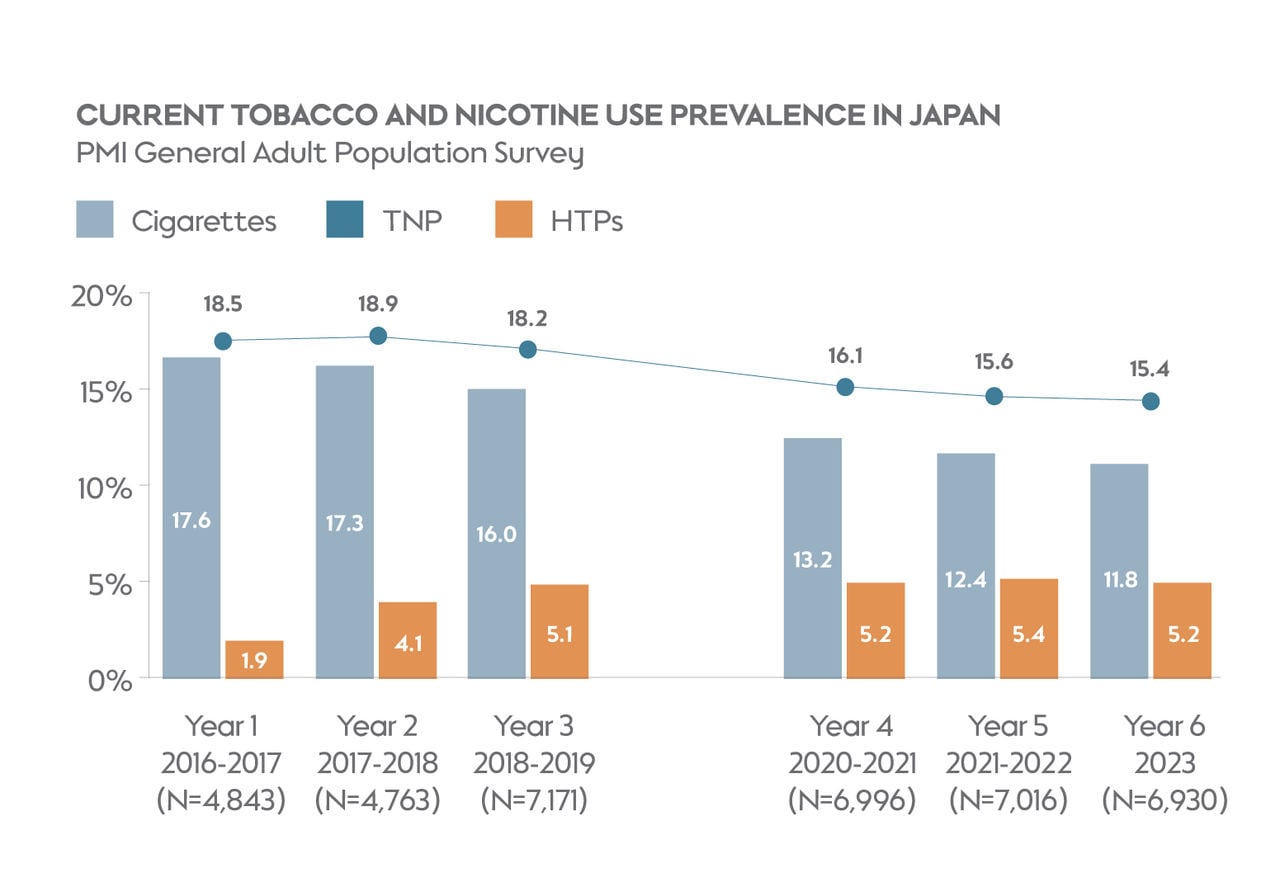
Our research clearly shows a steady reduction in overall tobacco use prevalence, which is consistent with the trends observed in the NHNS data. Since 2016, PMI has conducted the General Adult Population Survey. This is a yearly repeated, representative cross-sectional study which examines the tobacco usage prevalence and patterns among the general adult population (aged 20 and older) in Japan. This study has sampled and surveyed 4,000 to 7,000 participants every year. We have also surveyed adult users of THS over the same period of time, in our Adult THS Users Survey. In this study, we apply methods and protocols similar to those used in the NHNS to ensure national representation of the data. This research gives us a detailed view of how smoking and HTP use have been evolving in Japan.
At the start of our surveys, in 2016, about 18.5% of Japanese adults reported using TNPs. By 2023, this had fallen to 15.4% but, importantly, there was a significant reduction in cigarette smoking, from 17.6% to 11.8% during this period. At the same time, the proportion of adults using HTPs increased from about 1.9% in 2016 to 5.2% in 2023.
This shift from combustible to HTP use is in line with the Japan NHNS data and suggests that, overall, the introduction of HTPs in Japan has not increased tobacco product use but instead appears to be replacing combustible tobacco products.
What does the data show regarding dual use versus exclusive use?
Based on our research, most people don’t continue smoking once they adopt HTPs. Dual use of cigarettes and HTPs has remained low over time.
Looking at the patterns of tobacco product use among adults (aged 20 and older) in Japan, PMI’s General Adult Population Survey shows that, over time, the proportion of HTP users who do not smoke has increased, reaching 65% in 2023. This is a similar trend to what is seen in the 2023 NHNS data, which reports that approximately 75% of HTP users were not smoking cigarettes. This is further corroborated by PMI's Adult THS User Survey, which shows that, in the last 3 years of the survey, around 80% of HTP users had not used combustible tobacco products.
What does independent research conducted in Japan say about HTPs?
It’s reassuring that independent studies in Japan have observed similar trends when assessing the impact of HTPs on health. For example, four key studies backed by the Japan MHLW and affiliated institutes have provided valuable insights in several areas.
Chemical emissions
In a reduced emission study published in the Journal of University of Occupational and Environmental Health, researchers at the Japan National Institute of Public Health concluded that “The concentrations of nicotine in tobacco fillers and the mainstream smoke of IQOS were almost the same as those of conventional combustion cigarettes, while the concentration of TSNAs [tobacco-specific nitrosamines] was one fifth and CO [carbon monoxide] was one hundredth of those of conventional combustion cigarettes.”
Indoor air quality
The MHLW and the Japan National Cancer Center conducted two studies to examine the impact of HTPs on indoor air quality. They found that “Exposure to aerosol from HTPs in a designated smoking room under usual conditions is estimated to be tolerable since the lifetime cancer risk is expected to be below a VSD [virtually safe dose] of 10-5 (1/100,000), which is three orders of magnitude lower than that for cigarettes smoked under the same conditions.”
Research by the Health Service Division of the MHLW, published in the International Journal of Environmental Research and Public Health, compared the concentration of nicotine and particulate matter (PM2.5, particles that are 2.5 microns or less in diameter) in the air following 50 puffs from HTPs or cigarettes in a small, unventilated space (a shower cubicle). They found that the “…results do not negate the inclusion of HTPs within a regulatory framework for indoor tolerable use from exposure to HTP aerosol, unlike cigarette smoke.”
Youth and nonsmoker uptake
Finally, research data from Tottori University, commissioned by the MHLW, demonstrates low levels of HTP use by adolescents compared with cigarettes.
What lessons can we learn from Japan’s experience with HTPs, and could this success be replicated elsewhere?
Japan’s experience provides a compelling case study for tobacco harm reduction. The acceptance of HTPs in Japan has shown that providing adult smokers with scientifically substantiated, smoke-free alternatives to cigarettes can help reduce smoking prevalence much faster than through traditional measures alone, such as abstinence, and this can have potential benefits on public health.
Other countries are also considering the role of HTPs in tobacco harm reduction. For example, Public Health England has stated, “Alternative nicotine delivery devices, such as nicotine vaping products, could play a crucial role in reducing the enormous health burden caused by cigarette smoking.” Similarly, the U.S. Food and Drug Administration has established the modified risk tobacco product pathway which allows companies a way to gain authorization for commercialization of novel tobacco products, including smoke-free products, with health-related claims that differentiate them from combustible products.
These regulatory frameworks not only promote innovation but also emphasize the importance of consumer awareness and education in transitioning adult smokers who would otherwise smoke to potentially less harmful alternatives. As countries grapple with the complexities of tobacco control measures, collaboration among governments, health organizations, and the tobacco industry will be vital in shaping effective harm reduction strategies and policies.
At PMI, our roadmap for future studies includes continuing our cross-sectional surveys in Japan and conducting similar studies in other countries. This ongoing research, along with independent data from governments and academic institutions, will help inform policymakers about the potential benefits and risks of introducing smoke-free products in their countries.

Read the Scientific Update magazine
The Scientific Update magazine is focused on PMI's research and development efforts, milestone studies, industry regulations, and more. View the latest issue, or read the articles online.


